

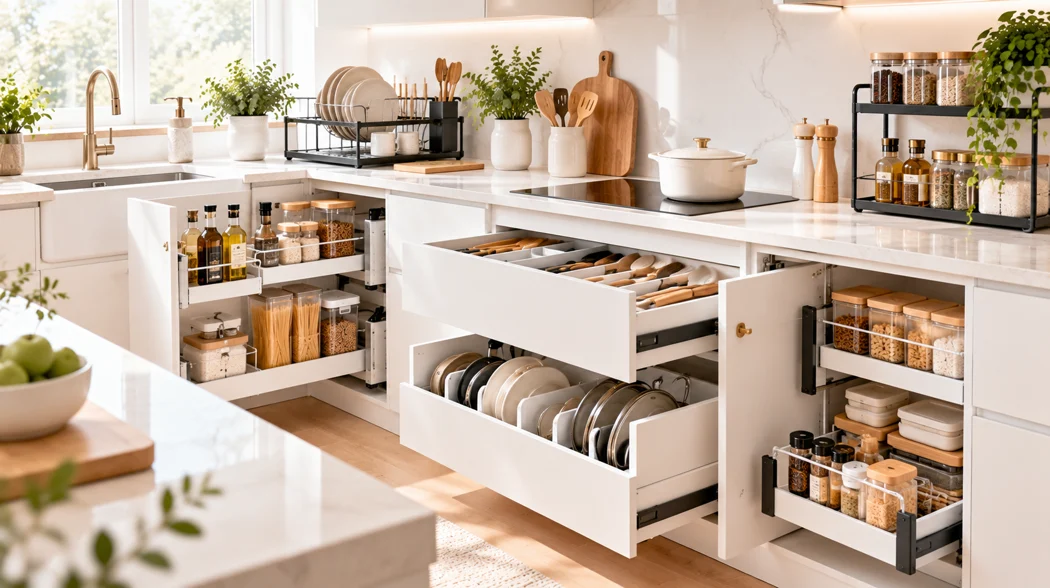
A cabinet can look spacious when it’s empty and feel impossible to use once everything goes back inside. Bottles disappear behind other bottles. Small items collect at the back. Reaching one thing means moving three others.
A pull-out cabinet organizer may help make that space easier to use—but only if it fits both your cabinet and the items you want to store.
Before you buy, use this simple approach: measure the opening, map the obstacles, and choose for the items you reach for most.
Start With the Cabinet Opening
The inside width of a cabinet isn’t always the width available to an organizer.
Door hinges, a center divider, and the edge of the door can narrow the space a sliding basket needs to pass through. An organizer might fit inside and still struggle to slide out.
Measure these four areas:
| Measurement | What to check |
|---|---|
| Clear opening width | The narrowest space between hinges, doors, or dividers |
| Usable depth | The distance available without blocking the door |
| Usable height | The space below an existing shelf or other obstruction |
| Pull-out clearance | The room in front of the cabinet for the organizer to extend |
Compare those measurements with the specifications of the exact product and option you plan to order.
Keep your measurements on your phone while shopping. A quick photo of the cabinet interior can also help you remember where the obstacles are.
Choose Around Your Tallest Everyday Item
Two tiers can provide separate places for smaller items, but the space between the tiers matters.
Before choosing an organizer, stand your tallest everyday bottle or container upright and measure it. Then check the usable clearance—not just the organizer’s overall height.
For example, a cabinet used for short jars has different needs from one used for tall cleaning bottles. More shelves won’t help if the items you use most cannot stand where you need them.
If two levels suit your items, explore The Kindra Two-Tier Pull-Out Cabinet Organizer. Review the listed dimensions and configuration against your cabinet measurements before choosing.
Give Each Level One Job
An organizer works better when you know what belongs in it.
Instead of filling every available gap, divide the space by task:
- Keep everyday items together.
- Give backup supplies their own section.
- Separate small accessories from taller containers.
- Leave enough room to remove an item without rearranging its neighbors.
For a kitchen cabinet, that might mean food-prep accessories in one area and spare supplies in another. For a bathroom cabinet, group items by routine.
Follow product labels when storing cleaning supplies, and keep them away from food and children.
Be Careful With Under-Sink Cabinets
Under-sink storage needs a separate fit check.
Pipes, shutoff valves, disposal units, and hoses can interrupt the space an organizer needs. A rack that works in a pantry cabinet may not fit beneath a sink.
Measure the clear space around those obstacles, and keep access to plumbing available. Don’t assume that a cabinet organizer is suitable for under-sink use unless its design and specifications support your layout.
When the available space is irregular, a smaller organizer in a clear section may be more practical than trying to fill the entire cabinet.
Compare the Details That Affect Daily Use
Before checking out, answer these questions:
- Does the organizer clear the cabinet opening?
- Do your items fit between the levels?
- Which sections slide or remain fixed?
- What installation does the product require?
- Are the listed materials and care instructions suitable for your intended use?
- Have you checked the shipping and return information?
You can also review The Kindra Slide-Out Two-Tier Cabinet Storage Rack as another option. Compare its actual specifications rather than assuming similarly named organizers have the same dimensions or features.
Buy for One Cabinet First
Start with the cabinet that causes the most daily frustration. Decide what will go inside, measure the available space, and choose an organizer that supports that specific routine.
You don’t need to reorganize the entire kitchen at once.
Ready to make your cabinet easier to use? View The Kindra Two-Tier Pull-Out Cabinet Organizer and compare it with your measurements.
Frequently Asked Questions
Can a pull-out organizer fit in a small cabinet?
It depends on the organizer’s dimensions, the clear cabinet opening, and any internal obstacles. Measure all three before ordering.
Is a two-tier organizer always better?
No. Two tiers may suit smaller items, while tall containers may need more open vertical space. Choose around what you plan to store.
Can I use a cabinet organizer under the sink?
Only when its dimensions, design, and installation requirements work with your plumbing layout. Keep valves and plumbing connections accessible.